

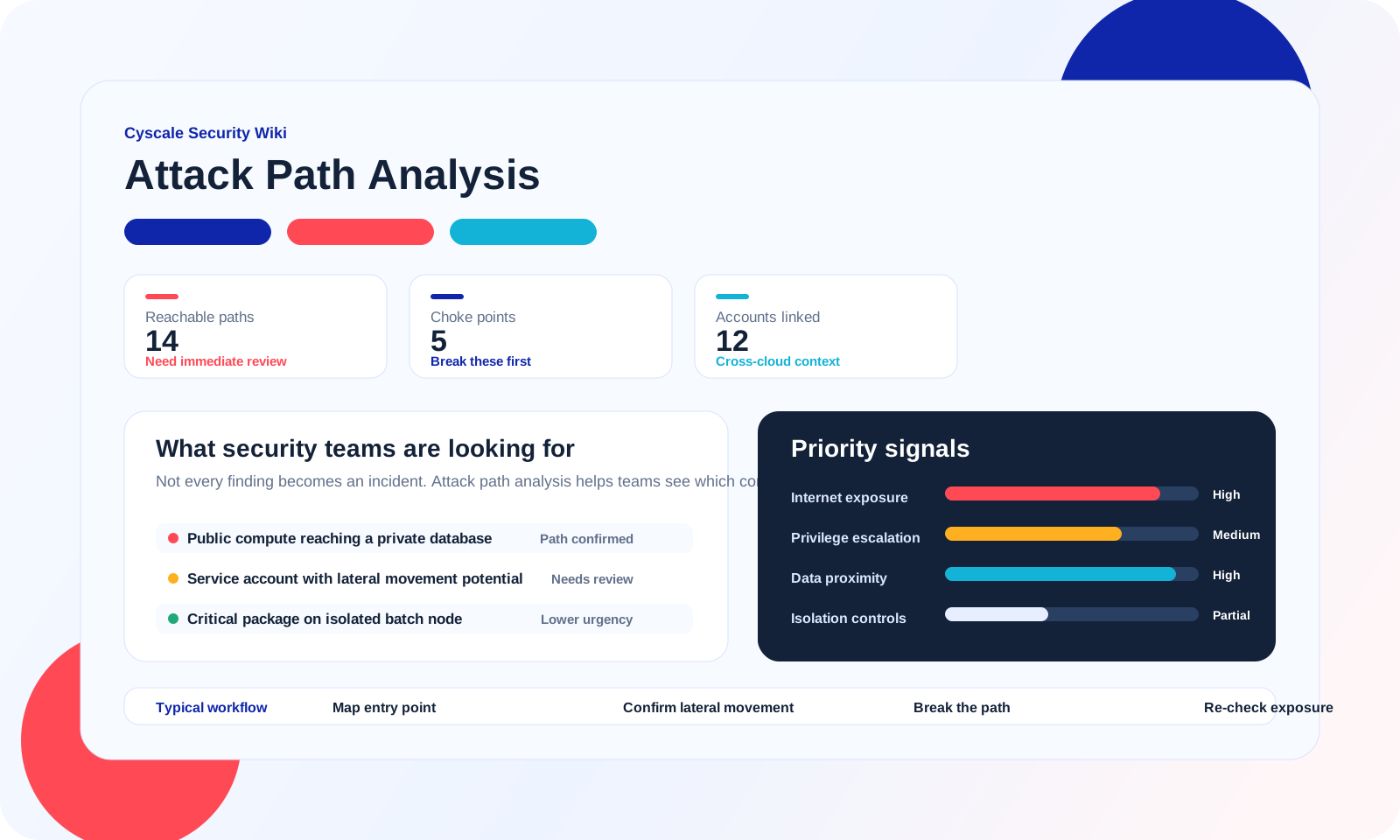
Security teams rarely struggle to find problems. They struggle to understand which combinations of problems are dangerous right now. Attack path analysis addresses that gap by showing how exposure, permissions, vulnerabilities, and data access fit together.
Instead of asking whether a single alert is severe, attack path analysis asks a better question: can an attacker actually move from an entry point to a sensitive asset or privileged action? That shift is what makes prioritization more realistic.
Why traditional queues fall short
Most tools still present risk as flat lists: one list for misconfigurations, another for vulnerabilities, another for identities. Teams then have to guess how those findings relate to each other.
Attack path analysis works because it treats the cloud as an interconnected system. It highlights the specific chain of conditions that would let an attacker move from initial access to lateral movement or data exposure.
- -A critical CVE on an isolated batch node is not the same as a moderate issue on an internet-facing service.
- -An overprivileged identity becomes more dangerous when it is attached to an exposed workload.
- -A storage asset matters more when a reachable path already exists to it.
What a real attack path usually contains
Most meaningful attack paths contain a mix of technical signals. They often start with exposure, continue with access or identity weakness, and end with impact against a business-critical asset.
- -An entry point such as a public IP, exposed application, open management port, or vulnerable API.
- -A weakness such as an exploitable package, weak authentication control, or overly broad trust relationship.
- -A movement step such as role assumption, workload-to-database access, or cross-account pivoting.
- -A target such as sensitive data, a production control plane, or a privileged identity.
How to operationalize it
The goal is not to document every theoretical route. The goal is to find the paths that matter enough to change prioritization and ownership.
Good programs start by identifying the entry points and crown-jewel assets that matter most, then use path analysis to understand how those two ends can connect.
- -Review attack paths for internet-facing and business-critical services first.
- -Break choke points that appear in multiple paths instead of treating every node as equal.
- -Track whether remediation actually removes the path, not just whether one finding changed state.
Key questions to ask
- -Can the platform correlate network exposure, identity permissions, vulnerabilities, and data access in one model?
- -Does it show which step breaks the path most efficiently?
- -Can teams explain the path clearly to engineering and leadership, not just to security specialists?
- -Is the analysis updated continuously as the environment changes?
Signals that should feed attack path analysis
- -Internet exposure and service reachability across load balancers, VMs, containers, Kubernetes, and APIs.
- -Identity relationships such as assume-role paths, inherited permissions, and excessive entitlements.
- -Vulnerabilities and misconfigurations that materially change exploitability or blast radius.
- -Sensitive data locations and business-critical assets that change the impact of a path.
How Cyscale operationalizes this
- -Cyscale uses graph context to connect reachability, identities, vulnerabilities, and data exposure into one operational view.
- -Teams can prioritize the step that actually breaks the route, not just the loudest alert in the chain.
- -The result is clearer ownership, lower triage effort, and remediation decisions that make business sense.
FAQ
Is attack path analysis only for enterprise-scale environments?
No. Smaller teams often benefit the most because they need help deciding what not to fix first. Path analysis reduces noise by focusing effort on the routes that could lead to real impact.
Does attack path analysis replace posture or vulnerability scanning?
No. It depends on those signals. The value is in combining them so teams can see how separate findings become one exploitable route.
What is the first practical use case?
Start with public entry points and production data stores. If you can understand how those two ends connect, you have a strong foundation for prioritization.


