

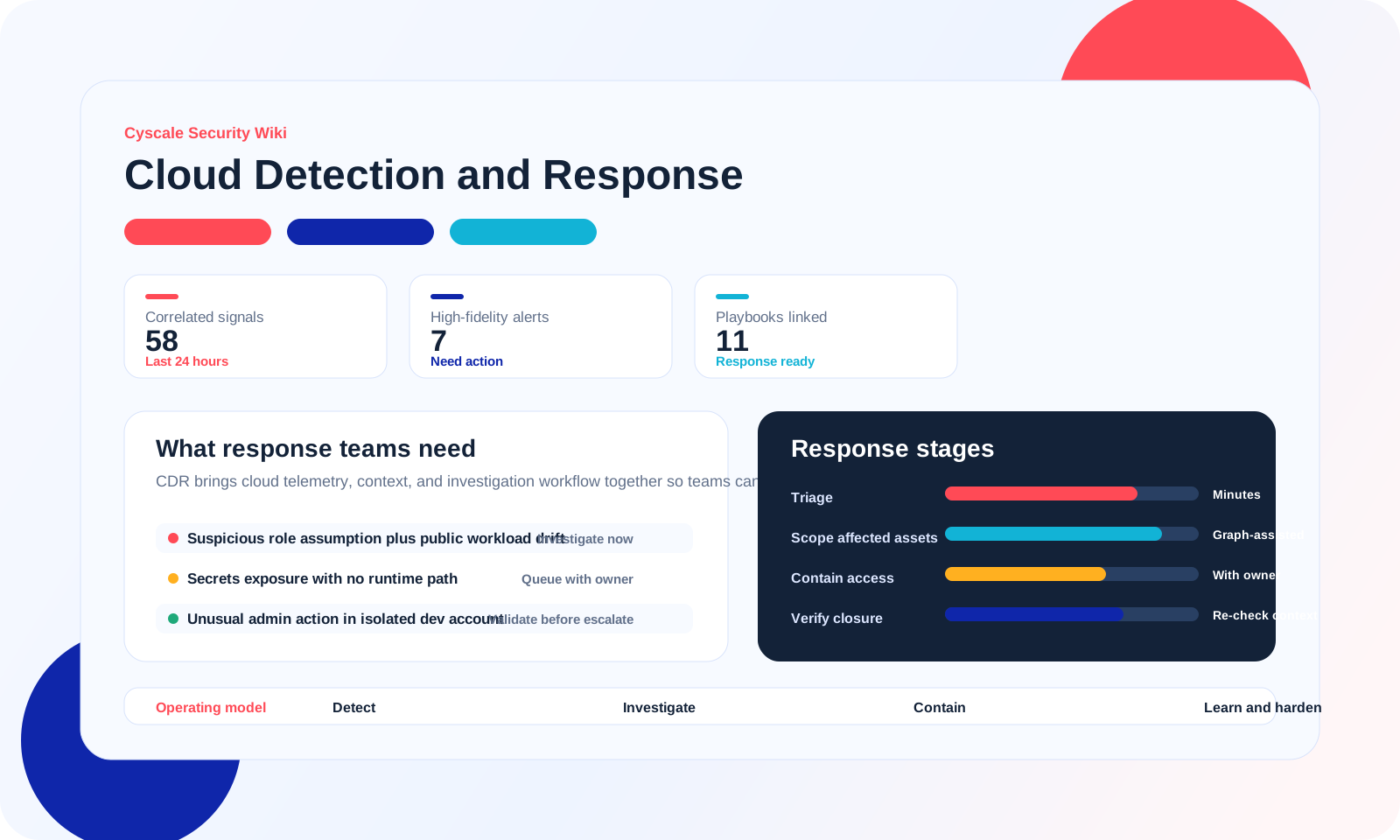
Cloud detection and response is not only about seeing suspicious activity. It is about deciding quickly whether a signal matters, what its blast radius might be, and which team should act first.
That requires more than raw telemetry. Cloud signals become useful when they are connected to the asset involved, the identity behind the action, the surrounding exposure, and the likely business impact.
Why cloud alerting often becomes noisy
Many teams receive large volumes of cloud alerts but still struggle to act with confidence. The problem is usually missing context, not missing data.
A signal that looks suspicious in isolation may become clearly urgent or clearly benign once you understand which workload, account, permission path, or data store is involved.
- -Alerts without ownership are slow to triage.
- -Telemetry without asset context is difficult to explain.
- -Containment decisions are harder when blast radius is unclear.
What strong CDR needs
The strongest cloud detection workflows combine detection and investigation rather than treating them as separate products. Context needs to arrive with the alert, not after three manual pivots.
- -Signal correlation across cloud logs, assets, identities, and exposure.
- -Fast scoping of affected resources, accounts, and likely paths.
- -Clear workflows for ownership, escalation, and containment decisions.
How teams make it operational
CDR becomes more effective when teams agree on a repeatable flow: confirm the signal, scope impact, contain where needed, and feed the lesson back into posture and engineering work.
This is where cloud detection meets platform security. The best teams use response events to improve guardrails, reduce repeated mistakes, and refine which alerts deserve high priority.
- -Use a shared triage workflow so alerts do not vanish into personal queues.
- -Include asset owner, environment, and exposure context in every investigation record.
- -Feed repeated response patterns back into custom controls or posture rules.
Key questions to ask
- -Can the detection workflow correlate events with asset, identity, and reachability context?
- -Can analysts scope impact without pivoting through multiple tools?
- -Does the platform support practical handoff to engineering or platform owners?
- -Can teams turn repeated incidents into stronger preventive controls?
What strong CDR programs usually combine
- -Cloud activity signals and suspicious events.
- -Asset, identity, and configuration context for investigation.
- -Triage states, ownership, and containment workflows.
- -Feedback loops into posture hardening and vulnerability prioritization.
How Cyscale operationalizes this
- -Cyscale helps teams investigate alerts with the cloud context needed to decide faster.
- -That means seeing the affected asset, related exposures, and identity relationships in the same workflow.
- -The result is a more practical response motion and a better bridge between cloud security and engineering teams.
FAQ
Is CDR the same thing as SIEM?
No. SIEMs centralize telemetry, while CDR is more focused on cloud-specific detection, investigation context, and response workflow. Many teams use both.
Why do cloud teams want board-style triage or workflow views?
Because response work is collaborative. Analysts, platform engineers, and service owners all need to see status, blockers, and ownership in the same queue.


