

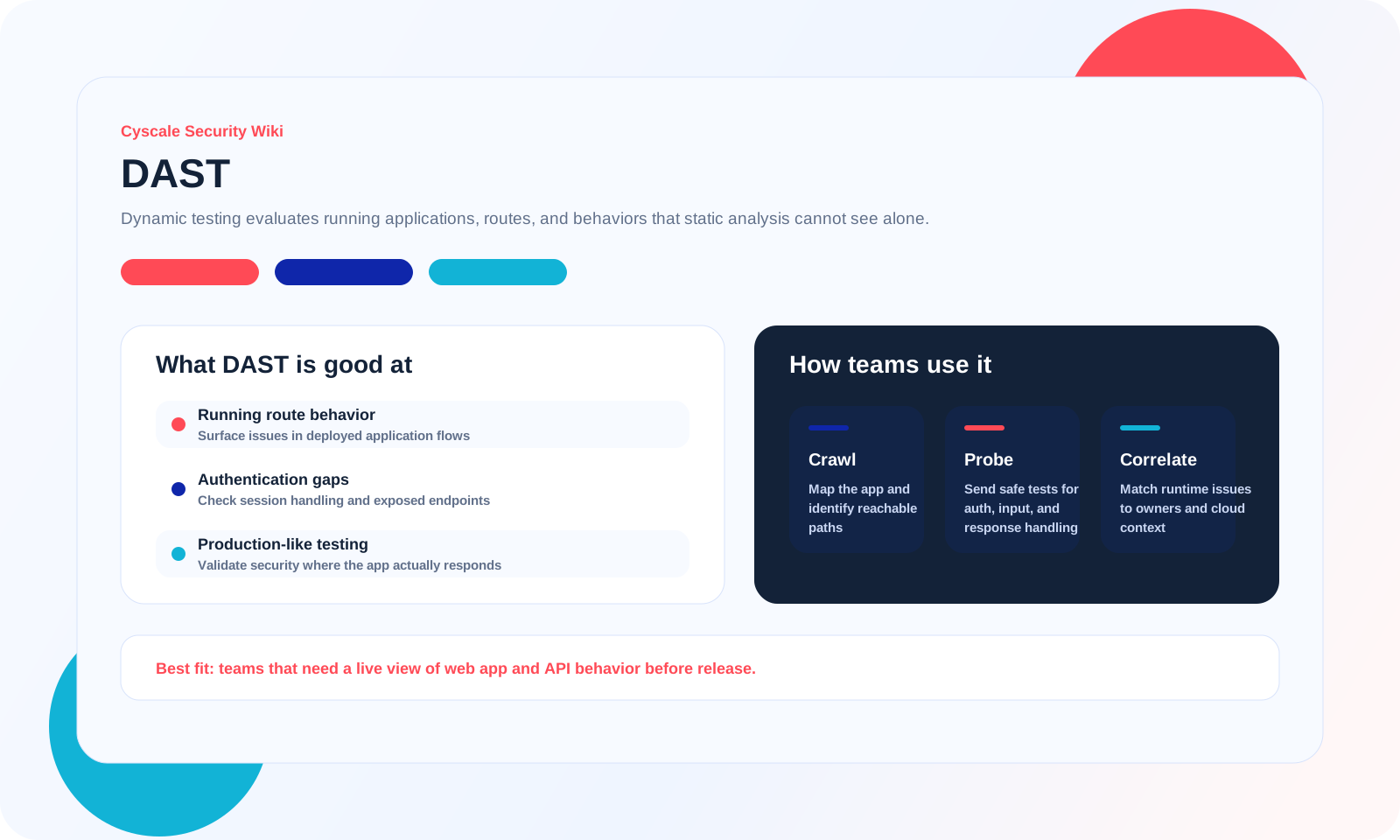
DAST observes application behavior instead of reading source code. That makes it useful for finding issues that depend on runtime configuration, authentication flows, error handling, and exposed endpoints.
Good DAST programs are scoped, authenticated, and safe to run continuously. Weak DAST programs either create too much noise or avoid realistic test coverage because the environment setup is incomplete.
Key questions to ask
- -Can the testing workflow handle authenticated sessions, multi-step forms, and modern single-page applications?
- -Is DAST coverage designed for both web interfaces and APIs?
- -Can runtime findings be linked back to application owners, releases, and dependency changes?
- -Does the program include guardrails so scans remain safe for staging and production-like environments?
What DAST is best at finding
- -Live web and API issues such as injection points, broken security headers, misconfigured authentication flows, and sensitive response exposure.
- -Problems that depend on runtime behavior, including redirect handling, cookie settings, transport protections, and unsafe default routes.
- -API and web paths that are reachable in staging or production but may not be obvious from code review alone.
- -Validation that fixes actually work, because DAST retests the live surface instead of only analyzing source.
Signals mature DAST programs rely on
- -Authenticated crawling so test coverage includes real user journeys instead of only public pages.
- -Safe probe libraries and payload sets that reduce business disruption during recurring scans.
- -API schema awareness so REST and GraphQL endpoints can be tested systematically, not just discovered by chance.
- -Retesting workflows that confirm remediation, rather than leaving old findings open indefinitely.
How Cyscale operationalizes this
- -Cyscale helps teams treat DAST as one part of a broader application and cloud risk picture, not a disconnected scan result.
- -Runtime findings can be reviewed alongside code, dependency, secret, and cloud posture context for better remediation order.
- -Security programs can show which exposed application risks are actually tied to important assets and business services.
FAQ
Does DAST require source code access?
No. DAST works against a running application, which is why it is useful for third-party apps, legacy systems, and black-box validation.
Can DAST replace SAST?
No. DAST and SAST answer different questions. The strongest programs use both because some issues are easier to find in code and others only appear at runtime.
Should DAST run only before major releases?
No. It is more useful when it runs continuously against controlled environments so teams catch regressions between major releases.


