

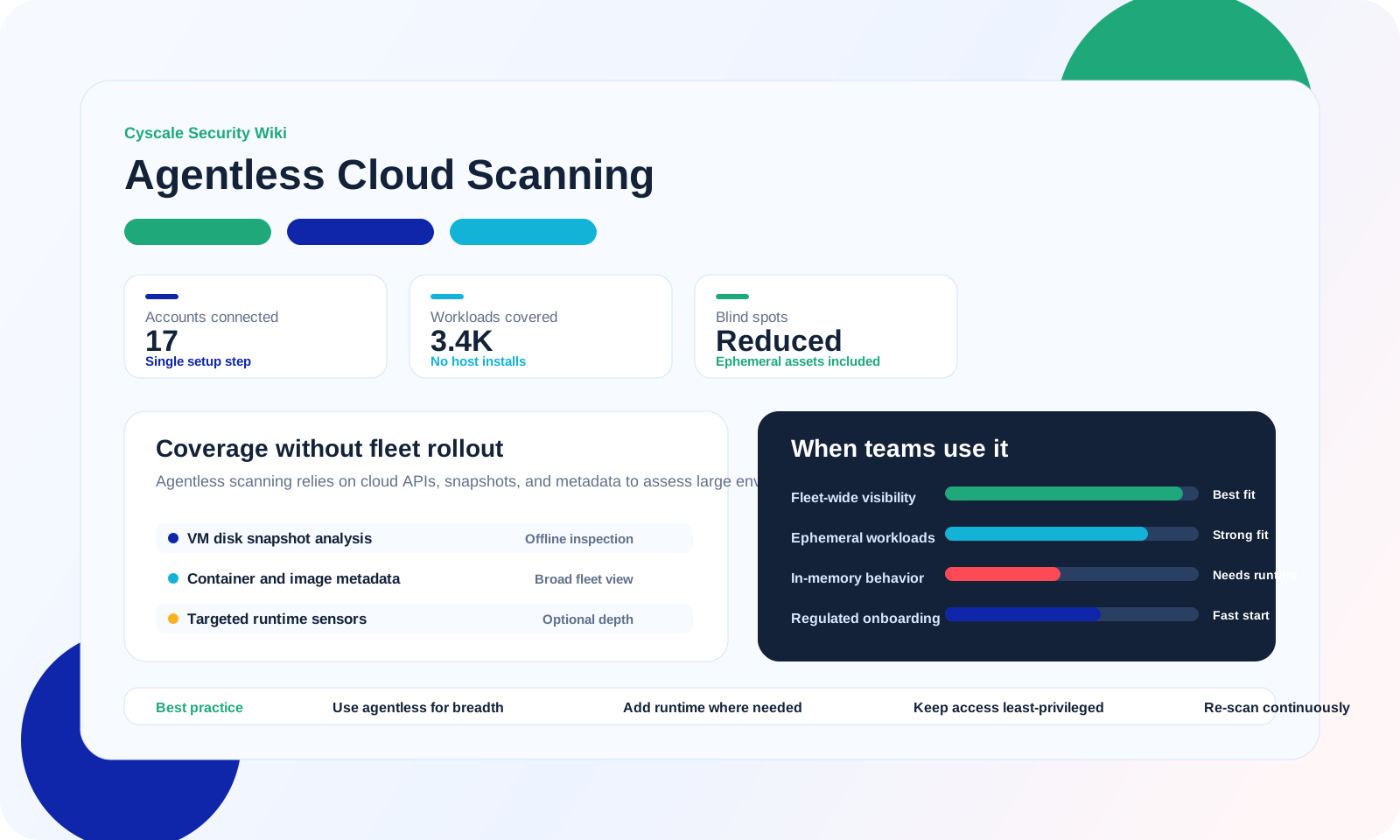
Agentless scanning has become central to modern cloud security because it reduces operational friction while expanding coverage. Instead of touching every workload, teams connect to cloud accounts and analyze assets using the provider’s own control-plane mechanisms.
That makes agentless scanning especially useful in dynamic environments where workloads appear and disappear quickly, ownership is distributed, and security teams need broad visibility fast.
How agentless scanning generally works
Different platforms implement it differently, but the usual pattern is similar: connect to the cloud with least-privileged access, gather metadata, inspect snapshots or artifacts, and correlate the results centrally.
- -Account-level onboarding instead of per-host deployment.
- -Offline or point-in-time inspection of workloads and storage.
- -Broad visibility across VMs, containers, storage, and configuration state.
Where it works best
Agentless scanning is especially strong when teams need fast breadth. It helps with posture visibility, vulnerability discovery, storage exposure, and broad fleet coverage across multiple accounts and clouds.
- -Organizations that want to onboard quickly across many accounts or subscriptions.
- -Teams with short-lived workloads that are difficult to manage with agents.
- -Programs that need broad visibility before adding deeper runtime inspection.
Where runtime still matters
Agentless coverage is powerful, but it does not eliminate the need for targeted runtime depth. Some attack patterns only become visible when you observe process, memory, or live execution behavior.
- -In-memory attacks or process-level runtime anomalies.
- -Very high-sensitivity workloads where deeper telemetry is justified.
- -Use cases that require confirmation of active package execution or live behavioral evidence.
Key questions to ask
- -Does the platform provide fast, least-privileged onboarding across cloud accounts?
- -Can it cover VMs, storage, containers, and configuration state without fleet-wide friction?
- -Does it explain where agentless coverage ends and runtime depth begins?
- -Can agentless findings be correlated with reachability, identities, and business context?
What teams often expect from agentless coverage
- -Cloud posture and misconfiguration discovery.
- -Vulnerability discovery across VMs, images, and some workload types.
- -Storage and data exposure visibility.
- -Fast scale across cloud accounts, subscriptions, and projects.
How Cyscale operationalizes this
- -Cyscale uses agentless visibility as a practical foundation for broad cloud coverage.
- -That allows teams to connect environments quickly and start identifying posture, exposure, and vulnerability issues without heavy rollout work.
- -From there, prioritization depends on context rather than raw discovery alone.
FAQ
Does agentless scanning mean no agents are ever needed?
Not always. Agentless scanning is excellent for broad visibility and fast onboarding, but some runtime or behavioral use cases still justify targeted sensors.
Why do teams prefer agentless-first onboarding?
Because it reduces operational friction, speeds deployment, and makes broad coverage practical in large, dynamic environments.


