

Security Operations Use Case
Secrets and Outdated Software
Cyscale helps teams identify leaked secrets and unsupported software, understand where they run, and remediate the issues that create the highest practical risk in cloud environments.
- Detect exposed credentials across code, artifacts, and deployment workflows.
- Track unsupported runtimes and software before they create urgent incidents.
- Prioritize hidden risks by real cloud exposure and workload importance.
Operational risk view
Reduce hidden cloud risk before it becomes urgent

Connect leaked credentials and unsupported software to the services, identities, and workloads they still affect so cleanup can be prioritized properly.
Live relevance
for secrets and outdated software findings that still affect running services and identities
Less hidden noise
when hygiene issues are separated from the findings that create real operational exposure
Clear cleanup
with better ownership for rotation, revocation, upgrades, and remediation tracking
What Cyscale helps teams improve
These workflows are strongest when teams understand whether a secret or outdated component still matters in production and who needs to act next.
Credential exposure visibility
Understand whether leaked tokens, keys, and credentials are still relevant to live services and cloud identities.
Unsupported software tracking
Identify outdated runtimes, end-of-life packages, and base images before they become a bigger attack-surface problem.
Faster cleanup
Give teams enough runtime and ownership context to rotate, upgrade, and remediate hidden risk more efficiently.
What you should expect
What you should expect from hidden-risk reduction
If you want to reduce hidden risk, you should expect a clean path from discovery to runtime context, prioritization, and owner-based cleanup.
You should expect
Find the exposure and the owner
Secrets and outdated software should be evaluated by where they run, what they can reach, and who needs to take action.
You should expect
Treat cleanup like risk reduction
You should be able to reduce hidden attack surface methodically instead of turning every hygiene issue into a fire drill.
With Cyscale
Context for targeted cleanup
Cyscale helps teams connect hidden-risk findings to workloads, identities, and cloud exposure so remediation work stays focused and defensible.
Detection with context
See whether a secret or outdated component still matters
Exposed credentials and outdated software are dangerous because they often stay invisible until they are linked to something important: a live workload, a privileged cloud identity, or an internet-facing service. That is why detection alone is not enough.
Teams need to know whether a leaked token still works, which repository or image contains it, which workloads rely on unsupported runtimes, and how those issues combine with exposure in the cloud.
- Understand whether leaked credentials are still active in production paths.
- Track end-of-life runtimes and outdated software in the workloads that matter most.
- Keep remediation based on actual exposure instead of broad hygiene assumptions.
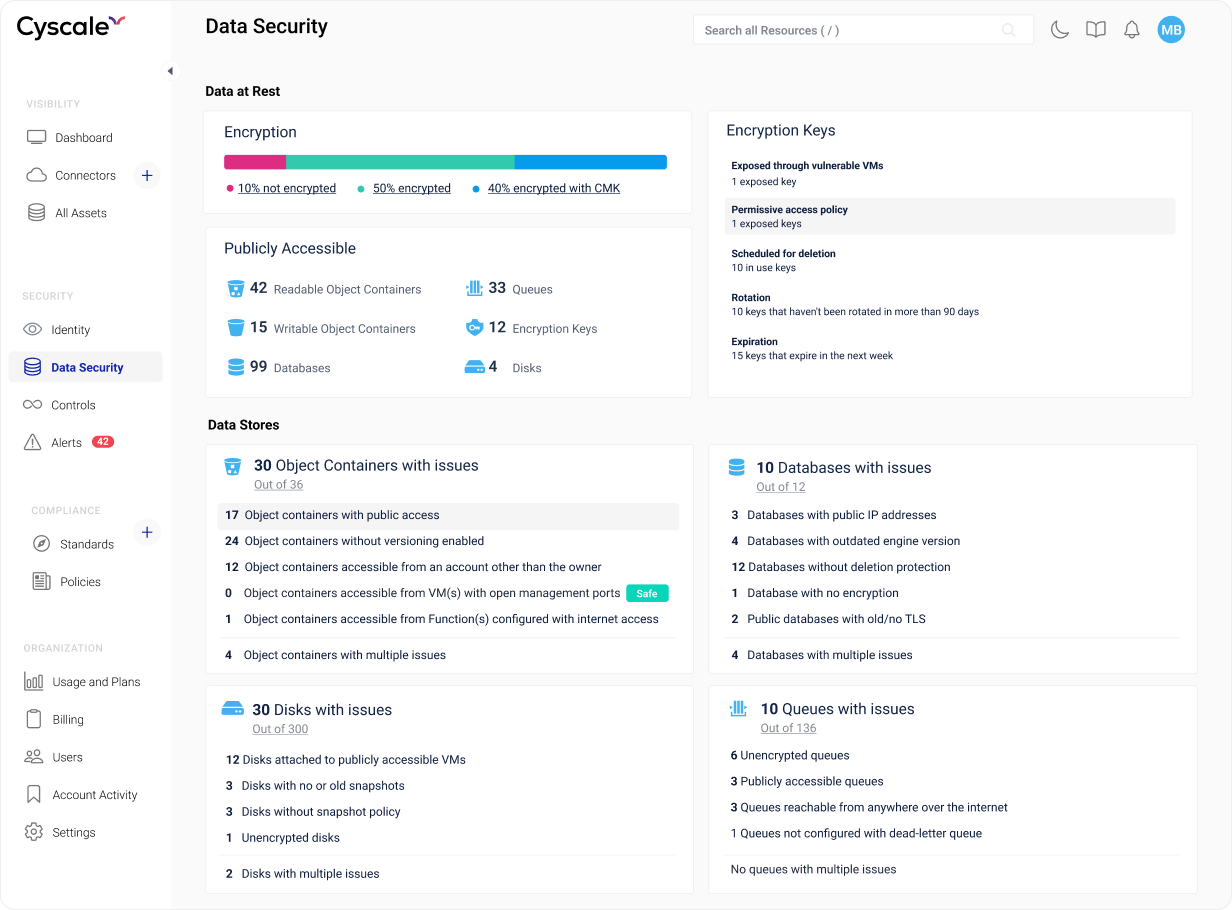
Use one view to understand which hidden-risk findings affect live services and where teams should spend cleanup effort first.
Cleanup
Give engineering a clearer path to reduce hidden attack surface
Teams need a workflow that translates secret and outdated-software findings into concrete next steps: rotate or revoke credentials, replace older components, and validate where the risk still exists.
Cyscale helps security and engineering leaders reduce the noise around these issues so the work can be scheduled and executed with less confusion.
- Prioritize rotation and upgrade work where exposure is highest.
- Improve handoff between security, platform, and engineering teams.
- Track progress as hidden cloud risk is reduced over time.

Better prioritization helps teams reduce hidden risk steadily without overwhelming engineering with undifferentiated hygiene tasks.
How teams handle hidden risk with Cyscale
The workflow is practical: find the issue, understand its live relevance, and send the right cleanup or upgrade action to the team that owns it.
Step 1
Detect high-risk exposure
Continuously identify secrets and unsupported software across repos, pipelines, artifacts, and deployed workloads.
Step 2
Understand where it matters
Connect those findings to the services, identities, and environments where they can realistically be abused.
Step 3
Reduce risk with less noise
Help teams rotate credentials, plan upgrades, and track remediation progress without treating every hygiene issue equally.
Related playbooks and product flows
Use these pages to connect posture findings, CVE triage, AppSec signals, and remediation workflows across the broader Cyscale platform.
FAQ
Why group secrets and outdated software together?
Both often create hidden risk that is underestimated until teams understand where the credential or unsupported component is actually deployed and what it can reach.
Is deleting a leaked secret enough?
No. Teams usually need to revoke or rotate it and then verify where that secret was used across builds, repos, and cloud environments.
Can outdated software be risky even without a high-profile CVE?
Yes. Unsupported software stops receiving fixes and guidance, which increases operational and security risk long before every issue becomes a headline vulnerability.


