

CONTENTS
What Is AI-SPM and Shadow AI?


CEO & Founder at Cyscale
Friday, May 15, 2026


AI is no longer a side experiment.
It is appearing in developer tools, cloud services, SaaS products, data pipelines, internal assistants, code-generation workflows, customer support processes, and automation agents. Some of that adoption is approved. Some of it happens before security, IT, data protection, or governance teams know it exists.
That unmanaged part is shadow AI.
AI Security Posture Management (AI-SPM) is the posture layer that helps organizations bring that adoption back into view. A useful AI-SPM program answers practical questions:
- Where is AI being used?
- Which models, agents, SDKs, services, endpoints, and SaaS AI features exist?
- Which systems can access customer data, source code, internal documents, logs, or regulated datasets?
- Which identities, tools, API keys, and permissions are involved?
- Which AI risks should be fixed first?
The important point is this: AI risk is rarely isolated inside a model. It usually becomes urgent because of surrounding cloud context: data access, exposed endpoints, leaked keys, broad identities, vulnerable packages, unsafe service settings, or unclear ownership.
What the AI-SPM market is converging on
The AI security market is moving quickly, but the core requirements are becoming clearer.
Wiz describes AI-SPM in terms of AI discovery and inventory, AI service cataloging, AI BOM, AI tool identification, AI security rules, sensitive data exposure, exposed AI endpoints, AI attack path analysis, and investigation workflows. Orca highlights AI and ML inventory, bill-of-materials visibility, shadow AI discovery, secure configuration checks, sensitive data detection, exposed access keys, and the need to avoid another siloed dashboard.
AI-native security vendors and research teams add another important angle: agents, tools, autonomy, model supply chain, prompt and data flows, runtime behavior, guardrails, red teaming, and AI bill-of-materials evidence.
The common lesson is not "buy a dashboard for AI." The lesson is that AI security must connect four layers:
- AI asset context: models, agents, endpoints, AI services, AI SDKs, notebooks, SaaS AI features, and APIs.
- Software and model context: packages, frameworks, libraries, datasets, pipelines, containers, repositories, and AI BOM evidence.
- Cloud context: identities, permissions, exposed endpoints, network paths, secrets, workloads, storage, and runtime environments.
- Business context: owner, approval state, environment, sensitivity, compliance impact, and remediation accountability.
Without those connections, AI inventory becomes another static list. With them, AI security becomes an operational workflow.
What is AI-SPM?
AI-SPM stands for AI Security Posture Management.
It is the discipline of continuously discovering AI systems, understanding how they are built and connected, checking their posture, and prioritizing remediation based on real exposure.
A mature AI-SPM capability should include:
- AI discovery and inventory,
- shadow AI detection,
- model, agent, service, endpoint, and SDK visibility,
- AI BOM or AI SBOM evidence,
- AI service configuration checks,
- sensitive data access analysis,
- exposed AI endpoint detection,
- AI key and secret exposure checks,
- identity and permission context,
- agent tool access review,
- ownership and approval state,
- attack-path or risk-path prioritization.
AI-SPM is not only for companies training foundation models. It applies to organizations using managed AI services such as Amazon Bedrock, Azure OpenAI, Google Vertex AI, OpenAI APIs, Hugging Face models, internal RAG applications, SaaS AI features, AI browser extensions, code assistants, and agents connected to business systems.
What is shadow AI?
Shadow AI is AI usage that happens without visibility, approval, monitoring, or governance from the teams responsible for security and risk.
It can include:
- employees pasting business data into unapproved AI tools,
- developers adding AI SDKs or hosted model APIs without review,
- model endpoints left running after experiments,
- AI API keys stored in repositories, CI systems, or notebooks,
- SaaS tools enabling AI features outside a central review process,
- browser extensions that process business content,
- AI agents connected to internal tools or APIs,
- prototypes using sensitive datasets,
- RAG systems built on internal documents without access review.
Shadow AI is usually not malicious. It happens because people are trying to move faster. That is exactly why blocking everything is rarely a durable strategy. If approved options are slow or unclear, teams route around them.
The better path is controlled enablement: discover what exists, create safe approved patterns, define data-handling rules, and prioritize only the AI usage that creates meaningful risk.
Why AI security needs cloud context
Many AI risks look familiar at first:
- public endpoints,
- leaked secrets,
- overprivileged identities,
- weak network controls,
- unencrypted or overexposed data,
- vulnerable packages,
- unmanaged workloads,
- missing logs,
- unclear ownership.
AI adds new questions on top:
- Which model is being used?
- Is the model hosted, fine-tuned, internal, third-party, or open source?
- Which datasets or documents can it reach?
- Are prompts, embeddings, responses, or training data retained?
- Which tools can an agent call?
- Can the agent write to systems or only read?
- Is an AI endpoint publicly reachable?
- Are AI service keys exposed in code or automation?
- Which package, framework, or model artifact introduced a vulnerability?
This is why AI-SPM should sit close to CNAPP, DSPM, CIEM, AppSec, vulnerability management, and compliance workflows. AI risk often becomes important because of how it connects to cloud resources, identities, data, code, and exposure.
What a useful AI-SPM platform should do
1. Discover AI usage continuously
Security cannot govern AI it cannot see.
AI-SPM should discover managed cloud AI services, custom model endpoints, AI SDKs, notebooks, AI-enabled workloads, SaaS AI features, model APIs, agents, and AI-related repositories. The inventory should update continuously because AI adoption changes faster than review cycles.
2. Separate approved AI from shadow AI
The goal is not to treat every AI system as an incident. Security teams need to distinguish approved AI usage, tolerated experiments, unmanaged systems, and unknown activity.
Useful metadata includes:
- account, subscription, project, or tenant,
- environment,
- owner,
- business purpose,
- approval state,
- connected workloads,
- data sources,
- identities and permissions,
- network exposure,
- model or package details,
- last activity.
3. Build AI BOM and AI SBOM evidence
Software teams already use SBOMs to understand packages and dependencies. AI needs a broader component view.
AI BOM or AI SBOM evidence may include:
- models,
- model sources,
- frameworks,
- packages and libraries,
- containers,
- datasets,
- fine-tuning artifacts,
- prompts and prompt templates,
- inference services,
- retrieval systems,
- pipelines,
- runtime dependencies.
This matters for vulnerability management, license review, supply-chain risk, incident response, customer assurance, and compliance.
4. Review AI agents by authority, not only by model
Agents deserve special attention because they can act.
An agent may call APIs, query databases, retrieve documents, create tickets, write code, trigger automation, update systems, or use a cloud identity. That makes its effective permissions as important as the model behind it.
Security teams should ask:
- What tools can the agent call?
- Which identity or token gives it access?
- Can it read sensitive data?
- Can it write to production systems?
- Can it call external services?
- Are its actions logged and attributable?
- Who owns the agent and approves tool changes?
5. Detect risky AI configurations
AI service posture checks should cover:
- public access,
- weak authentication,
- exposed model endpoints,
- excessive permissions,
- unsafe data sharing,
- missing encryption,
- insufficient logging,
- exposed AI keys,
- risky defaults,
- overly broad network reachability.
The exact controls vary by provider and architecture, but the principle is consistent: prevent AI systems from exposing data, credentials, prompts, outputs, or privileged actions.
6. Prioritize AI risk with graph context
Not every AI issue deserves the same urgency.
An internal experiment with no sensitive data and no public exposure is not the same as a public model endpoint using a broad service account and connected to customer data.
AI-SPM should prioritize the combinations that create real risk:
- AI endpoint exposed to the internet,
- sensitive data reachable by an AI system,
- AI key leaked in code or automation,
- agent with broad tool permissions,
- model package with known vulnerabilities,
- unmanaged AI usage in production,
- SaaS AI feature processing regulated data,
- missing owner or approval state for a high-impact AI system.
Where Cyscale fits
Cyscale is extending its cloud security platform with AI-SPM capabilities because AI security should not become another isolated tool category.
The goal is to connect AI security with the context teams already use in Cyscale:
- cloud asset inventory,
- security knowledge graph relationships,
- identities and permissions,
- data security posture,
- code and vulnerability context,
- exposed services,
- ownership,
- compliance evidence,
- remediation workflows.
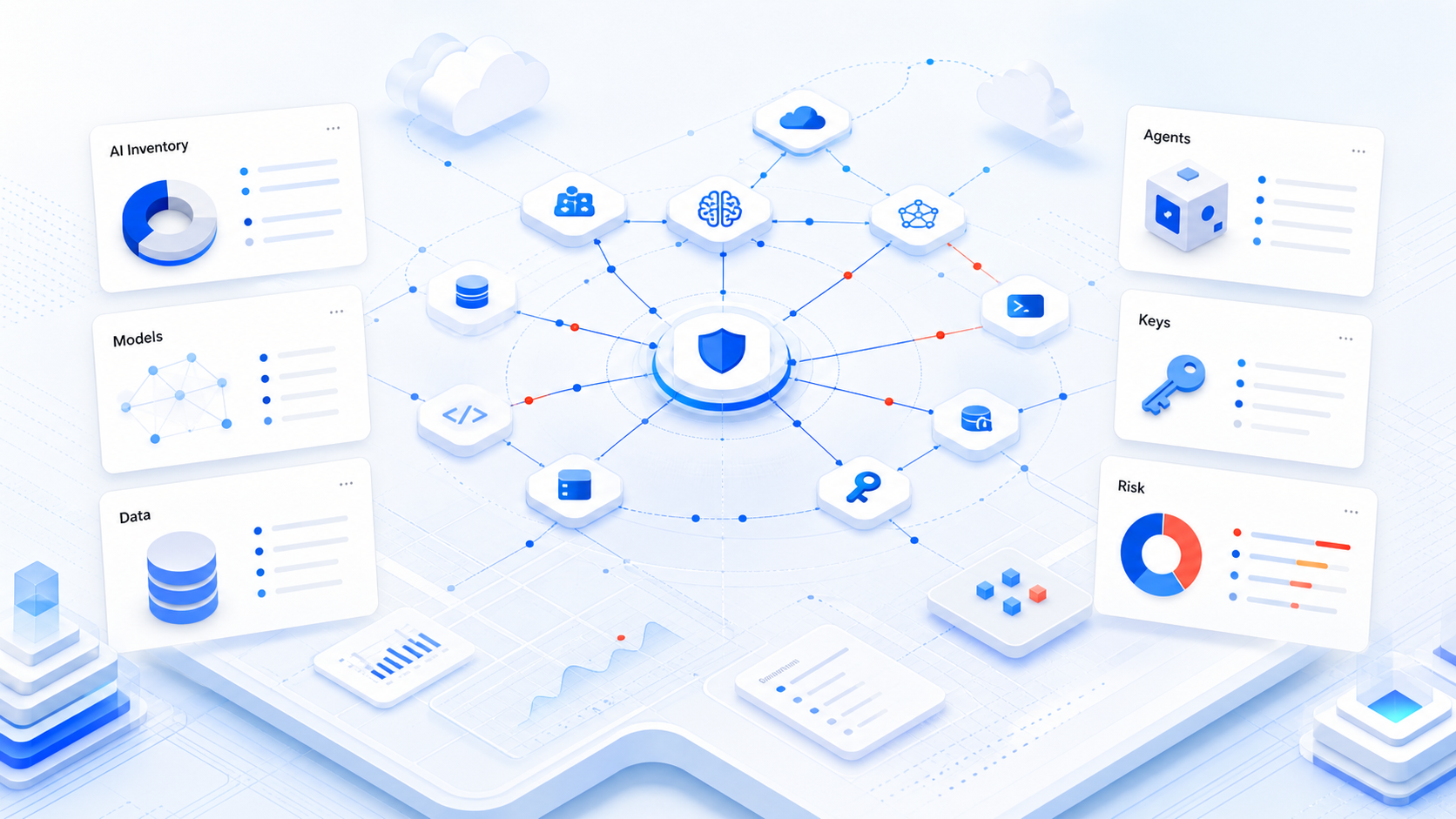
Cyscale will release AI-SPM capabilities soon as part of ongoing support for the AI technologies shaping how teams build, automate, and operate in the cloud.
This matters because an AI system rarely creates risk alone. Risk appears through the relationships around it: what data it can reach, which identity it uses, what endpoint exposes it, which repository defines it, which team owns it, and whether it sits in production.
Cyscale AI-SPM is designed to help teams move from "we think people are using AI" to "we know where AI is used, who owns it, what it can access, and what needs attention first."
How to start an AI-SPM program
Start with a practical operating model:
- Create an AI inventory across cloud, code, SaaS, and business workflows.
- Identify approved, tolerated, experimental, and unknown AI usage.
- Map AI systems to owners, accounts, environments, and business purpose.
- Review data access, sensitive datasets, prompts, embeddings, and retention.
- Check AI service keys, exposed endpoints, and risky configurations.
- Review agent tools, permissions, and delegated identities.
- Build AI BOM evidence for models, packages, frameworks, datasets, and runtime dependencies.
- Prioritize issues that combine AI usage with sensitive data, internet exposure, leaked keys, or broad permissions.
- Give teams approved AI patterns so safe adoption is easier than workarounds.
The first milestone is not perfect governance. It is trusted visibility that security, engineering, data, and governance teams can act on together.
FAQ
-
What is AI-SPM?
AI-SPM, or AI Security Posture Management, helps teams discover AI systems, understand models, agents, data access, endpoints, dependencies, and configuration posture, then prioritize remediation in cloud and software environments.
-
What is shadow AI?
Shadow AI is AI usage that happens without security, IT, or governance visibility. It can include unapproved AI tools, unmanaged model endpoints, AI SDKs, leaked AI keys, SaaS AI features, browser extensions, or internal agents that process business data.
-
Is AI-SPM the same as AI runtime protection?
No. AI runtime protection focuses on live prompts, outputs, abuse, and model behavior. AI-SPM focuses on posture: inventory, ownership, AI BOM, data access, permissions, service settings, exposed endpoints, keys, and remediation priority.
-
What is an AI BOM?
An AI bill of materials is an inventory of the components that make up an AI system, such as models, datasets, frameworks, packages, libraries, pipelines, containers, prompts, tools, and runtime dependencies.
-
Why do AI agents need special security review?
Agents can use tools and APIs, which means they may read sensitive data, write to systems, retrieve documents, update workflows, or act through cloud identities. Their effective permissions need to be reviewed like delegated authority.
-
Why does AI-SPM need cloud context?
AI risk often depends on cloud relationships: sensitive data access, exposed endpoints, identities, repositories, workloads, secrets, vulnerabilities, and misconfigurations. Cloud context helps teams decide which AI risks matter first.
-
How can teams reduce shadow AI risk without blocking innovation?
Start with visibility, approved alternatives, clear data-handling rules, owner mapping, and risk-based review. Blocking every AI tool usually drives more unmanaged usage; controlled enablement works better.
Further reading
Further reading
Cloud Storage
Misconfigurations

Build and maintain a strong
Security Program from the start.
Cloud Compliance in
2026: An In-Depth Guide
The whitepaper talks about ISO 27001, SOC 2, PCI-DSS, GDPR, HIPAA.
Download WhitepaperShare this article


Interesting? Share it


CEO & Founder at Cyscale
Ovidiu brings his cybersecurity experience to the table, innovating with AI-powered solutions that address the real-world challenges of cloud security. His approach is focused on providing SaaS companies with the tools they need to navigate the complexities of compliance and grow securely within their regulated environments.
Stay Connected
Receive our latest blog posts and product updates.


