

Security Operations Use Case
AI Security
Give security teams the facts behind AI adoption: where AI is used, what agents and models can access, which data is involved, and which risks need action before approved AI becomes unmanaged exposure.
- Create an inventory of approved, unmanaged, and experimental AI usage across cloud, code, SaaS, and business workflows.
- Review AI agents, models, tools, data access, identities, and ownership before they become production risk.
- Prioritize dangerous combinations such as exposed AI endpoints, sensitive data access, leaked keys, and overprivileged agents.
AI security operating model
Discover, govern, and remediate AI risk in cloud context
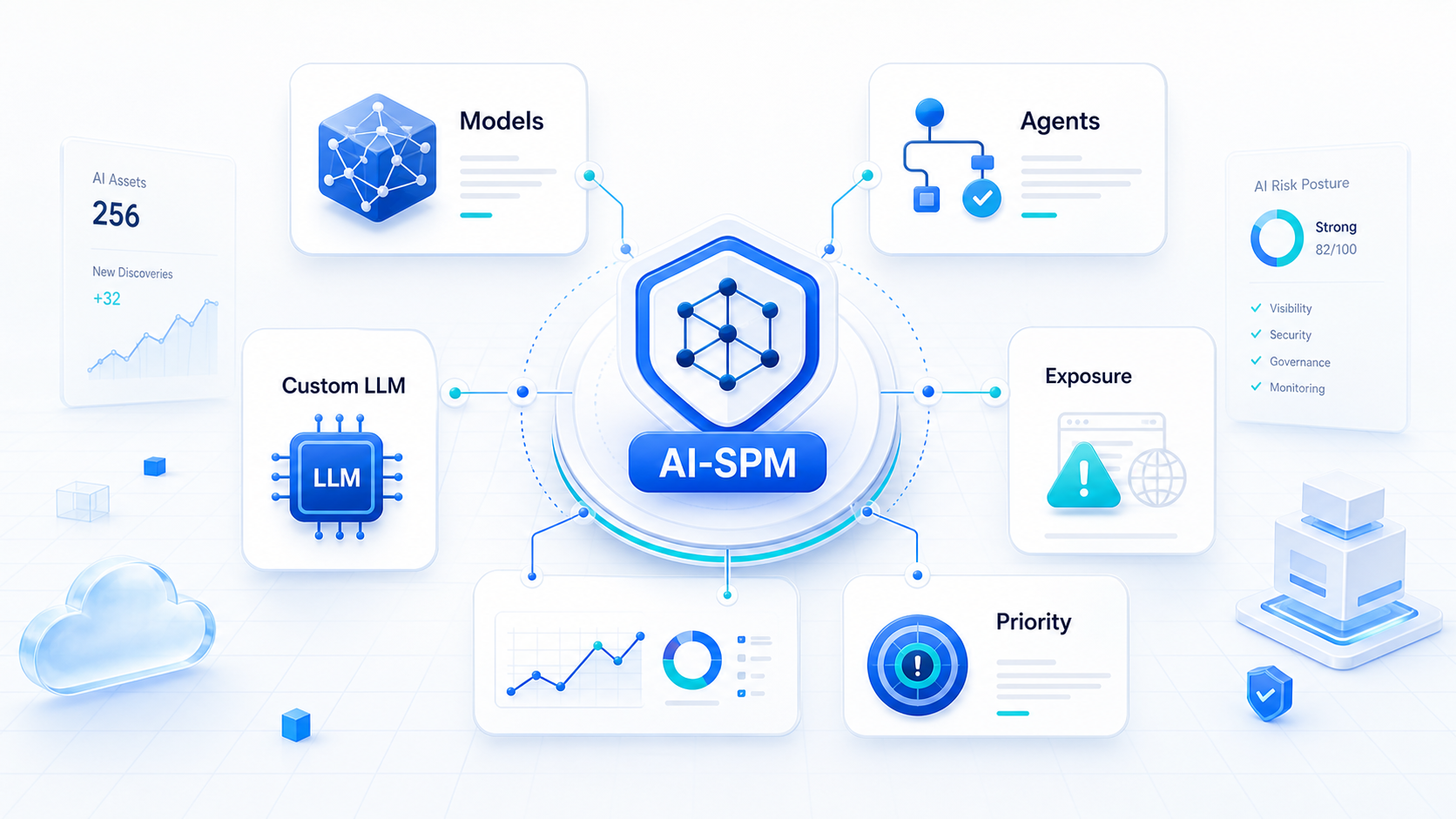
AI security succeeds when teams can see where AI is used, what data it touches, what tools agents can call, and which risks deserve action first.
Discover
AI services, model endpoints, AI-enabled apps, agent workflows, SaaS features, and AI SDKs
Govern
models, agents, tools, prompts, datasets, identities, owners, approval status, and retention expectations
Remediate
risks that combine exposure, sensitive data, weak controls, vulnerable packages, or broad permissions
What an AI Security program needs to operationalize
The goal is not to block productive AI usage. The goal is to give security, engineering, data, and governance teams a shared operating model that turns AI adoption into visible, reviewable, and fixable work.

Shadow AI discovery
Find unmanaged AI apps, cloud AI resources, model endpoints, SaaS AI features, AI SDKs, notebooks, and agent experiments before they become blind spots.
ExampleEngineering adds an AI SDK to a service and a team turns on a SaaS AI feature. Cyscale helps security see both as AI usage that needs an owner and approval status.

Agent and model governance
Understand what agents can do, which tools they can call, which models they use, and which cloud identities or APIs give them authority.
ExampleAn internal agent can search documents, call deployment tooling, and update tickets. Cyscale frames the review around tools, identity, data access, and the owner responsible.

AI data protection
Identify prompts, datasets, repositories, storage buckets, logs, embeddings, and documents that AI systems can read, process, or expose.
ExampleA vector store contains customer records and is connected to an exposed model endpoint. Cyscale shows the data path so security can prioritize access controls and exposure reduction.

AI BOM readiness
Track models, packages, frameworks, libraries, containers, datasets, and runtime dependencies so security and compliance reviews have evidence.
ExampleA notebook moves into production as an inference service. Cyscale helps teams retain evidence for the model, framework, packages, image, dataset, and runtime location.
Why it matters
AI security decisions need more than model names
A model endpoint, an AI assistant, or an automation agent is only understandable when teams can see data access, identity scope, network exposure, tools, ownership, and deployment context.
Blind spot
Shadow AI expands faster than policy
Employees and teams adopt AI to move faster. Without discovery, security cannot tell the difference between useful experimentation and unmanaged exposure.
New authority
Agents create action paths
Agent workflows can call APIs, retrieve documents, write code, update systems, or trigger automation. Their effective permissions need review.
Real exposure
AI risk follows data and identity
The highest-risk AI issues are often connected to sensitive data, broad identities, public endpoints, leaked credentials, or weak service settings.
Familiar operating model
A security workflow AI teams recognize
Most AI security programs need the same checkpoints: inventory, authority, data, and action. Cyscale keeps those checkpoints tied to live cloud evidence so governance starts from facts, not guesswork.
Know what AI exists
Build a working inventory across managed AI services, self-hosted model servers, agents, SaaS AI features, SDKs, keys, and notebooks.
ExampleA team deploys a model server in Kubernetes while another enables a SaaS assistant. Both appear as AI usage with environment and owner context.
Review what AI can do
Evaluate agent tools, service roles, delegated permissions, API integrations, and approval status before AI systems can affect production.
ExampleAn internal agent can search docs and update tickets, so the review focuses on tool scope, identity, and the responsible team.
Trace sensitive data paths
Understand which datasets, vector stores, prompts, logs, repositories, and storage buckets an AI workflow can read or expose.
ExampleA model endpoint is low priority until Cyscale shows it can retrieve embeddings built from customer records.
Prioritize risky combinations
Move the most dangerous combinations into remediation first: public endpoints, leaked keys, broad permissions, and sensitive data access.
ExampleA public AI endpoint with a broad service role and customer-data access becomes an immediate security workflow.
Visibility
Build an AI inventory that security and governance teams can trust
AI adoption often starts outside formal procurement: a data team uses a hosted model, engineering adds an AI SDK, a team turns on a SaaS AI feature, or someone connects an agent to internal tools.
Cyscale helps turn this activity into an inventory security can use, with ownership, environment, data, identity, and exposure context included from the beginning.
- Inventory AI usage across cloud provider services, workloads, repositories, SaaS integrations, and model endpoints.
- Classify approved, tolerated, experimental, and unknown AI usage.
- Give governance teams live evidence instead of manual questionnaires and stale spreadsheets.
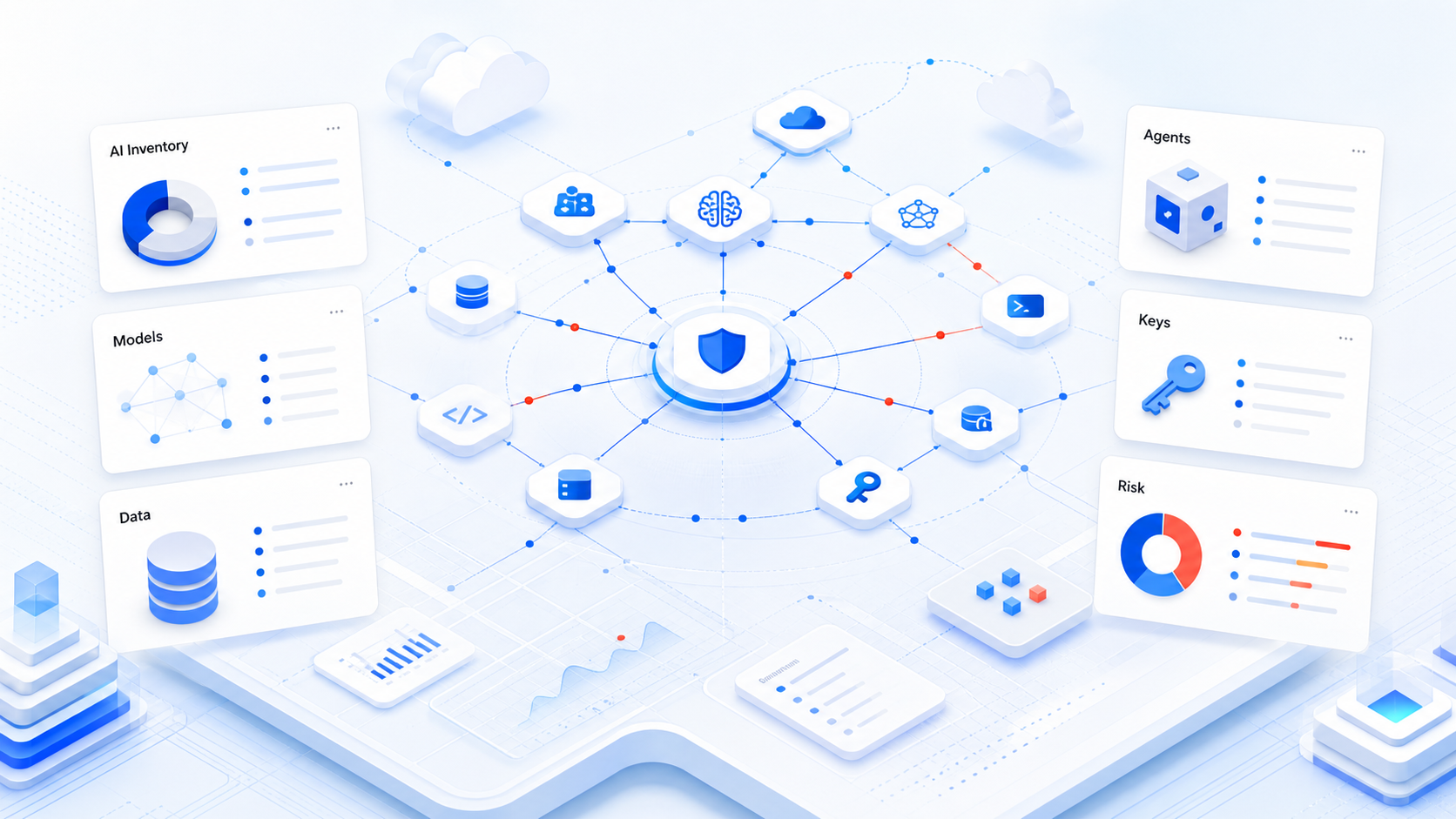
The first practical AI security milestone is evidence-backed visibility: where AI exists, who owns it, and what it can reach.
Governance
Govern AI agents by what they can access and do
Agentic AI changes the security model because agents can use tools, call APIs, retrieve internal content, and act on behalf of users or services. Treating them as simple chat interfaces misses the point.
Cyscale helps teams review agents through the lens of cloud security: inherited identity, data access, tool scope, exposed endpoints, approval status, and remediation owner.
- Review tool access, service accounts, API integrations, and delegated permissions.
- Identify agents that can reach sensitive data or production workflows.
- Connect agent risk to the cloud identities and workloads that enforce real authority.
Ask what the agent can do
The important question is not only which model is used. It is which tools, APIs, repositories, tickets, data stores, or workflows the agent can touch.
Match governance to evidence
Policy is easier to enforce when security can show live data access, identity scope, and ownership rather than relying on manual attestations.
Remediation
Reduce AI risk without slowing approved adoption
Blocking every AI tool usually pushes adoption further into the shadows. A better operating model gives teams approved paths while surfacing the AI usage that creates measurable risk.
Cyscale brings AI findings into cloud security workflows so remediation can focus on the risk combinations that matter most.
- Prioritize public AI endpoints, leaked AI keys, sensitive data access, and overprivileged agents.
- Route findings to owners with account, environment, service, and data context.
- Support secure AI adoption with evidence that engineering and governance teams can act on.
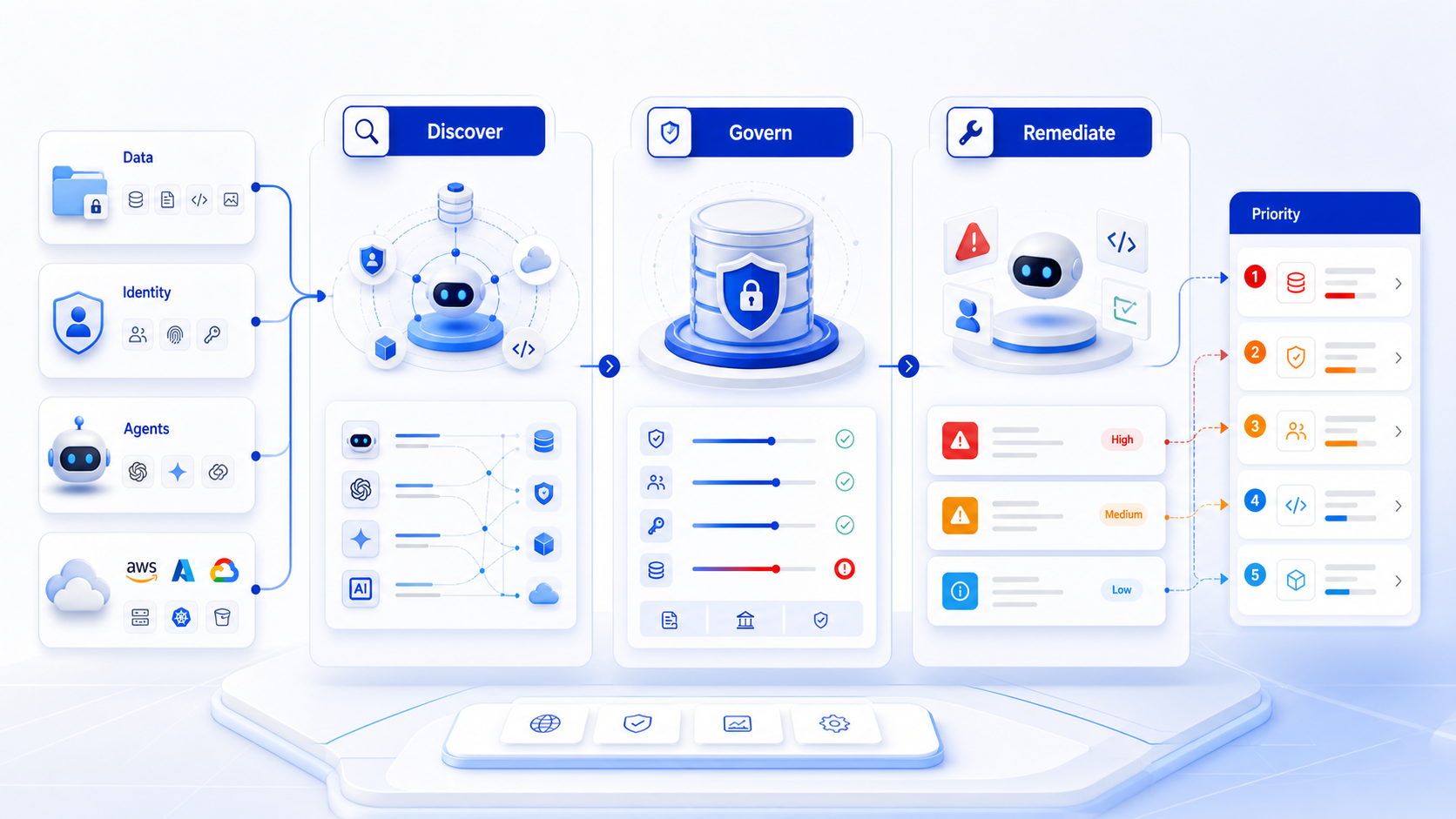
A practical AI security operating model turns discovery into governance and governance into focused remediation.
A practical AI Security operating model
Useful AI security programs move in a repeatable loop that saves review time: make AI visible, enrich it with context, rank risk, and give teams a clear path to safe adoption.
Step 1
Discover AI usage
Find shadow AI, provider-native AI services, AI-enabled workloads, agents, models, SaaS features, and AI SDKs.
Step 2
Classify and enrich
Add ownership, approval state, environment, data access, identity scope, AI BOM, endpoint exposure, and business context.
Step 3
Prioritize risk
Focus on combinations such as sensitive data access plus public exposure, leaked keys, or overprivileged agent permissions.
Step 4
Remediate and govern
Send clear actions to owners, keep approved AI paths open, and use evidence to improve governance over time.
Start with visibility
Turn AI adoption into something security can govern
Cyscale gives AI Security teams a practical starting point: discover what AI exists, understand what it can access, and focus remediation on the risks that combine models, agents, sensitive data, exposure, and identity permissions.
- Bring shadow AI, agents, custom LLMs, and approved AI services into a shared operating view.
- Show business owners exactly why a risk matters: exposure, data access, permissions, and priority.
- Help teams adopt AI safely without pushing useful experimentation back into the shadows.
Connect AI Security to platform controls
AI risk becomes easier to manage when it is connected to AI-SPM, data security, identity context, and the broader CNAPP workflow. These pages explain the surrounding controls.
FAQ
What is AI Security for cloud environments?
AI Security for cloud environments covers discovery, governance, posture assessment, data protection, identity review, AI BOM context, agent permission review, endpoint exposure, and remediation of AI systems connected to cloud services, Kubernetes workloads, code, and SaaS integrations.
What is shadow AI?
Shadow AI is AI usage that happens without security, IT, or governance visibility. It can include unmanaged AI tools, model endpoints, AI SDKs, SaaS AI features, browser extensions, or internal agents that process business data.
Why should security teams care about AI agents?
AI agents can take action through tools and APIs. Security teams need to know what agents can access, which permissions they inherit, and whether they can affect sensitive data or production systems.
How do we reduce shadow AI without blocking innovation?
Start with visibility, approved alternatives, clear data-handling rules, owner mapping, and risk-based remediation. Blocking every AI tool usually creates more unmanaged usage.
Where does AI-SPM fit in an AI Security program?
AI-SPM provides the posture layer: inventory, AI BOM, data access, identity context, exposure, configuration checks, and risk prioritization. It complements runtime guardrails and governance policy.
Which AI risks should teams prioritize first?
Start with combinations that create practical exposure: public AI endpoints, agents with broad tool permissions, AI services that can reach sensitive data, unencrypted training or inference data, weak guardrail settings, leaked AI keys, vulnerable AI runtime packages, and unclear ownership.
How does Cyscale help AI, cloud, and security teams work together?
Cyscale connects AI assets to cloud accounts, owners, identities, data stores, Kubernetes workloads, exposed paths, compliance controls, and remediation workflow. AI teams get asset and component context, while security teams get risk evidence and prioritization.
Can Cyscale identify AI workloads outside managed AI services?
Yes. AI usage is not limited to Bedrock, SageMaker, Vertex AI, or Azure AI. Cyscale also tracks AI SDKs, model servers, vector databases, notebooks, agent services, Kubernetes workloads, container images, and packages that indicate self-hosted AI activity.
Does AI Security require users to update connector permissions?
For full AI coverage, yes. Some cloud providers require additional read permissions for AI services. Cyscale can guide users through provider-specific permission updates and resync connectors after the cloud-side changes are confirmed.


