

CONTENTS
EU AI Act Enforcement: How to Keep AI Cloud Infrastructure Compliance Ready


CEO & Founder at Cyscale
Monday, June 29, 2026


The EU AI Act is no longer a distant regulatory concept.
It is now moving through a phased enforcement model, with several obligations already in application and the main body of rules approaching fast. For cloud, platform, security, and compliance teams, the practical question is not only "Which AI systems are regulated?"
The harder question is:
Can we prove what AI exists in our cloud, what it can access, which controls apply, who owns remediation, and what evidence shows that risk is under control?
That is where AI governance becomes cloud infrastructure work.
The AI Act creates obligations for providers, deployers, importers, distributors, and other operators depending on the AI system, use case, and risk category. Some organizations will be directly in scope because they build or deploy high-risk AI systems. Others may not be high-risk AI providers, but still need a defensible operating model for AI inventory, data protection, identity control, exposure management, and evidence collection.
This article summarizes the enforcement model and explains how Cyscale helps keep AI cloud infrastructure compliance ready.
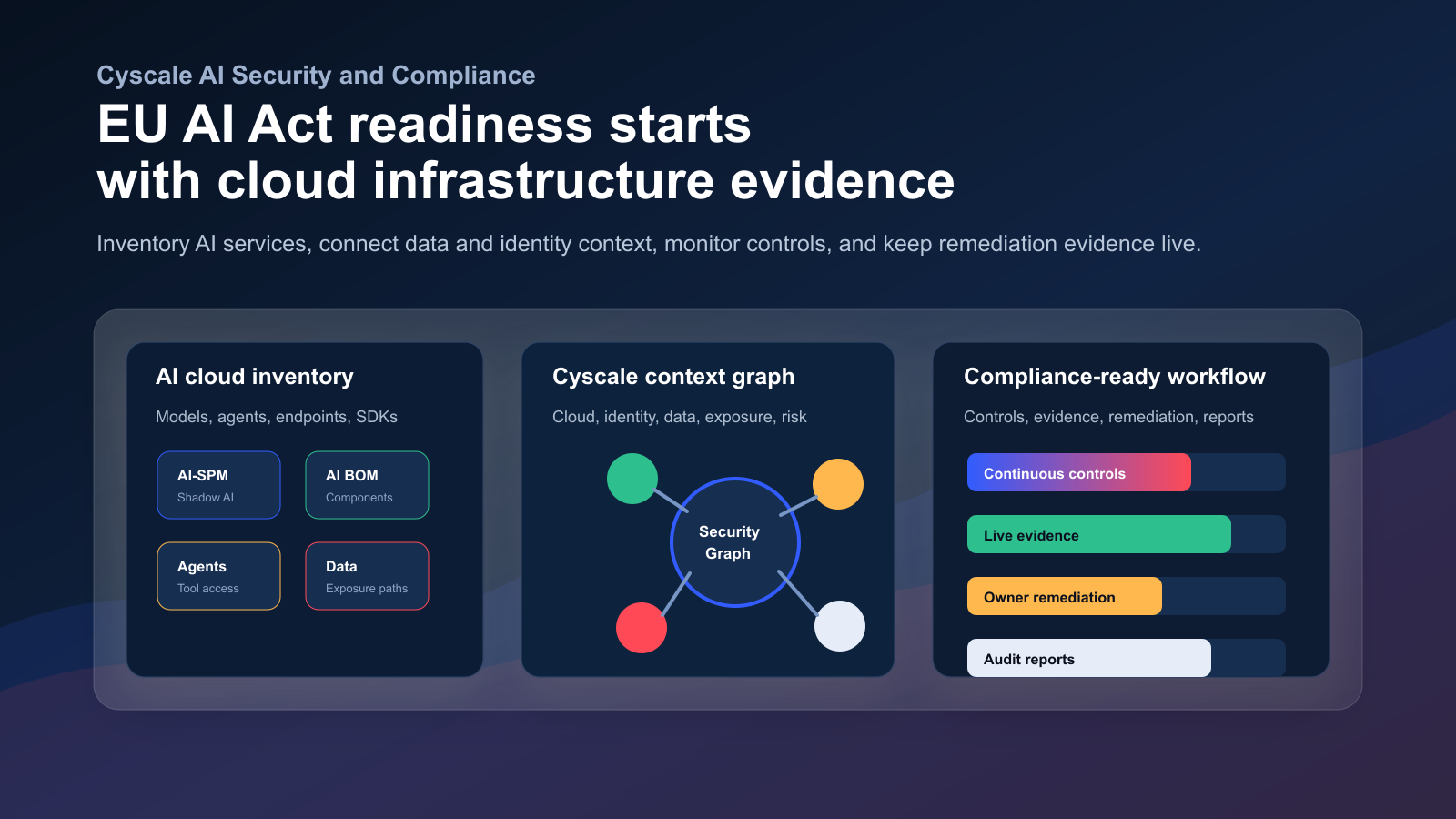
How the EU AI Act is enforced
The AI Act uses a hybrid enforcement model.
At EU level, the European AI Office sits within the European Commission and plays a central role in implementation, especially for general-purpose AI models. The official AI Office page says it can support implementation, evaluate GPAI models, request information and measures from model providers, investigate possible infringements, and apply sanctions.
At national level, Member States rely on national competent authorities. The Commission's Governance and enforcement of the AI Act page explains the split:
| Authority | What it does | |---|---| | European AI Office | Oversees implementation and enforcement in the EU, with a special role for the most powerful general-purpose AI models. | | Market surveillance authorities | Supervise and enforce rules for AI systems, including prohibited practices and high-risk AI systems. | | Notifying authorities | Designate and supervise notified bodies that carry out pre-market conformity assessment. | | European AI Board | Coordinates Member State authorities and supports consistent implementation. | | Scientific Panel | Provides independent scientific expertise, including on systemic risks. | | Advisory Forum | Brings stakeholder input from industry, startups, SMEs, academia, civil society, and other groups. |
For cloud teams, this matters because enforcement will not come from one place only. A foundation model provider may face EU-level AI Office scrutiny, while an organization deploying a high-risk AI system may deal with a national market surveillance authority, a sector regulator, or both.
The latest application timeline
The European Commission AI Act page lists a phased timeline. As of the page update available on 11 May 2026, the key dates are:
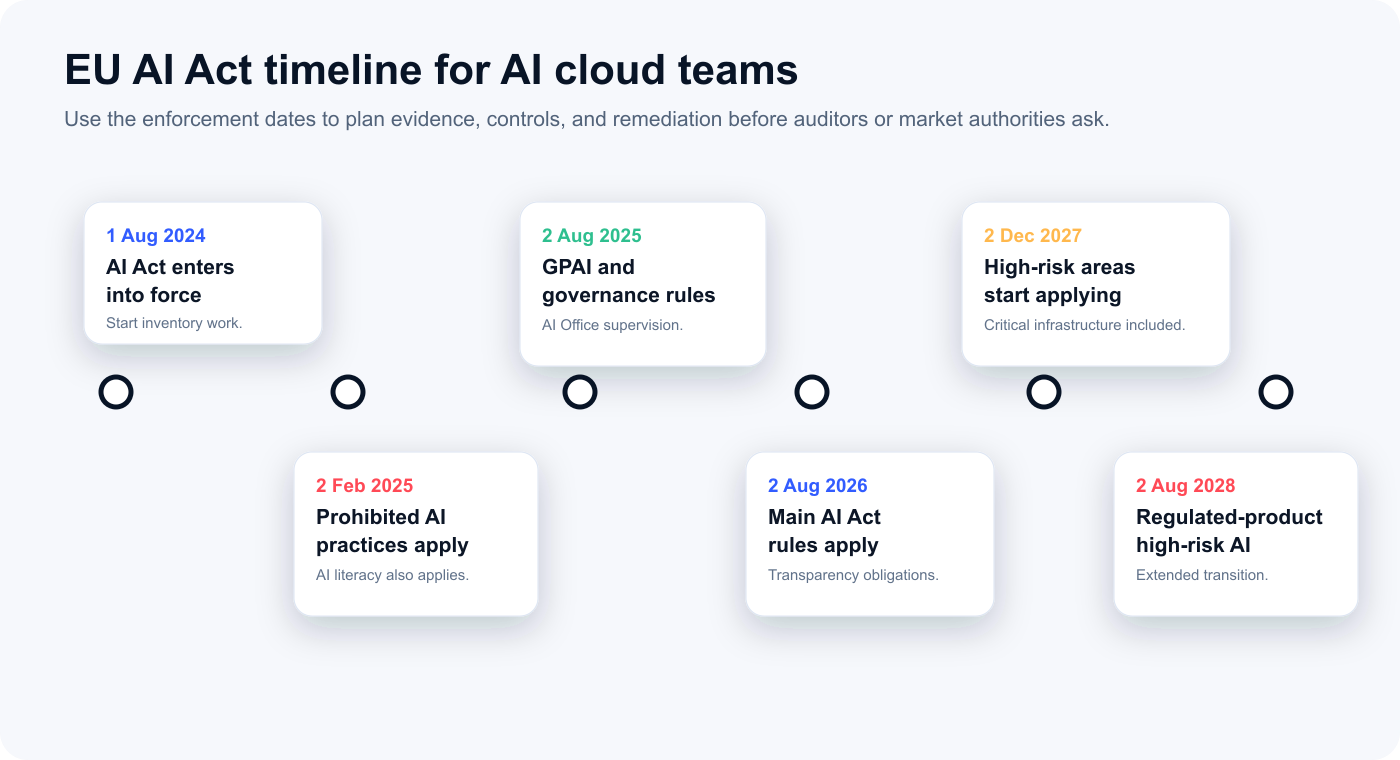
| Date | What applies | |---|---| | 1 August 2024 | The AI Act entered into force. | | 2 February 2025 | Prohibited AI practices and AI literacy obligations entered into application. | | 2 August 2025 | Governance rules and obligations for general-purpose AI models became applicable. | | 2 August 2026 | The AI Act becomes broadly applicable, including transparency obligations under the main application timeline. | | 2 December 2027 | Rules for systems used in certain high-risk areas, including biometrics, critical infrastructure, education, employment, migration, asylum, and border control, apply under the Commission's AI Omnibus timeline. | | 2 August 2028 | Rules apply for high-risk systems integrated into regulated products, such as lifts or toys, under the extended transition period. |
The timeline has changed in important ways through the AI Omnibus simplification process. Teams should keep monitoring official EU guidance, but the direction is clear: AI governance is becoming operational, evidence-driven, and enforceable.
Penalties are large enough to make evidence a board-level topic
The official Regulation (EU) 2024/1689 sets out the penalty structure in Articles 99 and 101.
| Violation type | Maximum administrative fine | |---|---| | Non-compliance with prohibited AI practices under Article 5 | Up to EUR 35 million or 7% of total worldwide annual turnover, whichever is higher. | | Other operator or notified-body obligations, including provider, deployer, importer, distributor, high-risk, and transparency obligations listed in Article 99 | Up to EUR 15 million or 3% of total worldwide annual turnover, whichever is higher. | | Incorrect, incomplete, or misleading information to notified bodies or national competent authorities | Up to EUR 7.5 million or 1% of total worldwide annual turnover, whichever is higher. | | GPAI provider infringements under Article 101 | Up to EUR 15 million or 3% of annual total worldwide turnover, whichever is higher. |
There are SME and startup adjustments in Article 99, and regulators must consider the specific circumstances of each case. Still, the enforcement signal is obvious: paper-only AI governance will not be enough.
Organizations need live infrastructure evidence.
Why AI cloud infrastructure becomes part of AI Act readiness
Many AI Act conversations start with model behavior, risk classification, and user transparency. Those are necessary, but they are not sufficient.
In real environments, AI systems depend on cloud infrastructure:
- managed AI services such as Amazon Bedrock, Azure OpenAI, Google Vertex AI, and other provider-native services,
- model endpoints, notebooks, vector databases, RAG pipelines, and inference APIs,
- Kubernetes workloads, containers, serverless functions, queues, storage buckets, databases, and logs,
- user identities, service accounts, tokens, API keys, secrets, and non-human identities,
- CI/CD pipelines, repositories, packages, model artifacts, and AI SDKs,
- SaaS AI features and agent workflows connected to internal tools.
That infrastructure determines whether an AI system can access sensitive data, reach the internet, expose an endpoint, call privileged APIs, retain prompts or outputs, or act through broad permissions.
For AI Act readiness, cloud evidence should answer practical questions:
- Where is AI used across accounts, subscriptions, projects, clusters, repositories, and SaaS integrations?
- Which AI systems are approved, experimental, unknown, or shadow AI?
- Which systems touch personal data, confidential business data, source code, regulated datasets, or customer content?
- Which identities and permissions give agents, services, and workloads real authority?
- Which AI endpoints are public, weakly authenticated, or reachable from risky paths?
- Which AI workloads use vulnerable packages, outdated images, exposed secrets, or weak logging?
- Which controls are failing, who owns them, and what remediation evidence proves progress?
Without those answers, AI governance becomes a spreadsheet exercise. With them, AI compliance can become an operational workflow.
What Cyscale helps teams keep ready
Cyscale does not replace legal classification, conformity assessment, or legal counsel. It helps security, cloud, and compliance teams maintain the technical evidence and remediation workflows needed to support AI governance.
The platform is designed around context: cloud assets, identities, data, vulnerabilities, exposure paths, controls, ownership, and remediation all need to connect.
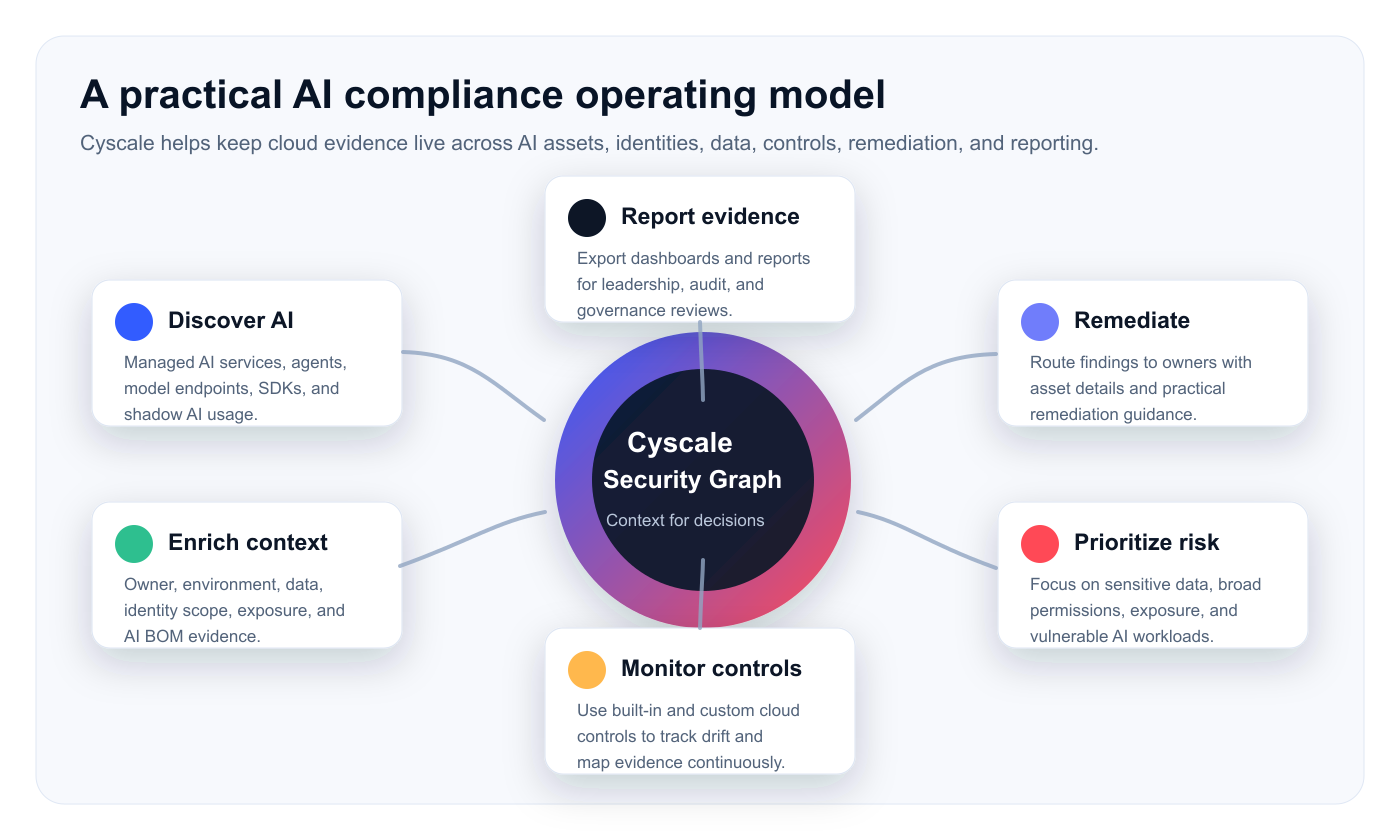
1. Discover AI systems and shadow AI
The first readiness gap is usually inventory.
AI adoption happens in managed cloud services, data science notebooks, SaaS features, code repositories, Kubernetes workloads, internal assistants, RAG applications, and agents connected to business systems. Some of it is approved. Some of it is experimental. Some of it is invisible to security.
Cyscale AI Security and AI-SPM help teams move from guesswork to an operating inventory:
- AI services, agents, model endpoints, SDKs, and self-hosted AI workloads,
- approved, tolerated, experimental, and unknown AI usage,
- AI BOM evidence such as models, frameworks, packages, libraries, containers, datasets, and runtime components,
- ownership, environment, account, project, and business context.
This matters for the AI Act because governance starts with scope. You cannot classify, document, monitor, or remediate AI systems that nobody knows exist.
2. Connect AI to data, identity, and exposure
AI risk is rarely isolated inside a model. It usually becomes serious because of what surrounds the model.
A model endpoint connected to public internet exposure, a broad service account, and sensitive customer data deserves a different priority than an internal experiment with no sensitive data and narrow permissions.
Cyscale's Security Knowledge Graph connects the surrounding signals:
- cloud accounts, subscriptions, projects, and environments,
- identities, permissions, users, roles, service accounts, and non-human identities,
- data stores, sensitive data paths, and exposure context from DSPM,
- attack paths, network exposure, public endpoints, and reachable workloads,
- vulnerabilities, packages, containers, images, and runtime context,
- owners, alerts, controls, and remediation state.
That gives governance teams a more defensible view of AI cloud risk. Instead of asking only "Which model is used?", teams can ask "What can this AI system access, who owns it, and what would happen if it failed?"
3. Monitor controls continuously
The AI Act does not give cloud teams a single universal checklist. Controls depend on the system, use case, role, risk category, sector, and technical design.
Still, AI-ready cloud infrastructure needs continuous control coverage in familiar areas:
- access control and least privilege,
- logging and monitoring,
- encryption and key management,
- network exposure and endpoint protection,
- secret handling and API key protection,
- vulnerability and package risk,
- data access and retention,
- backup, resilience, and incident response readiness,
- ownership and remediation routing.
Cyscale supports this through Cloud Security Posture Management, CNAPP, and Cloud Compliance. The platform includes 500+ out-of-the-box security controls and supports custom controls through Query Builder, helping teams turn policy expectations into repeatable cloud checks.
For AI infrastructure, that means you can build control evidence around the services, data stores, identities, and workloads that actually support AI systems.
4. Prioritize the AI findings that matter
AI programs can quickly create another noisy dashboard. That is not helpful when engineering teams already have posture, vulnerability, identity, and data findings to handle.
Cyscale helps prioritize AI cloud risk by looking for dangerous combinations:
- public AI endpoints with weak authentication,
- AI systems that can access sensitive data,
- agents with broad tool or API permissions,
- AI service keys exposed in code, CI/CD, notebooks, or automation,
- vulnerable AI workloads connected to production environments,
- storage buckets, logs, embeddings, or prompt stores with weak controls,
- unclear owners for systems that process regulated or customer data.
This is the difference between "we found AI" and "we know which AI infrastructure risk should be fixed first."
5. Route remediation with evidence attached
Readiness is not only a status badge. It is the ability to show that failed controls become owned work, remediation guidance is clear, and risk actually goes down.
Cyscale connects failed controls and alerts to affected assets, owners, and remediation guidance. Recent platform improvements also make remediation content easier to read and more specific to the asset and alert context, helping teams move faster from finding to fix.
For AI cloud infrastructure, that remediation workflow can support:
- narrowing an overprivileged agent identity,
- restricting a public model endpoint,
- rotating exposed AI service keys,
- encrypting logs, prompt stores, datasets, or embeddings,
- tightening access to vector databases or storage buckets,
- patching vulnerable containers or packages,
- adding logging and monitoring to AI workloads,
- documenting exceptions when a risk is accepted temporarily.
The point is to keep evidence close to action. When a regulator, auditor, customer, or board asks what changed, teams should not have to reconstruct the story manually.
6. Report compliance progress clearly
AI Act readiness will involve more than security operations. Legal, privacy, risk, engineering, data, procurement, and leadership teams all need usable evidence.
Cyscale helps teams communicate progress through dashboards, filtered views, and reports. Exportable evidence matters because AI governance often needs to support:
- internal risk reviews,
- customer security questionnaires,
- board updates,
- audit preparation,
- regulator-facing documentation,
- remediation tracking across teams.
The best reporting is not a static snapshot. It is a view of the current cloud environment, the controls that failed, the assets affected, and the work still open.
A practical AI Act readiness checklist for cloud teams
Use this checklist as a starting point for AI cloud infrastructure readiness:
- Build a live inventory of AI services, endpoints, agents, SDKs, notebooks, model APIs, and SaaS AI features.
- Label AI usage by approval state, owner, environment, business purpose, and data sensitivity.
- Map AI systems to data stores, identities, permissions, network exposure, repositories, packages, and runtime assets.
- Identify prohibited-use risk and policy violations early, especially where AI touches employees, customers, biometric data, vulnerable groups, or regulated decisions.
- Separate GPAI provider obligations from downstream deployer and AI system operator responsibilities.
- Define controls for logging, access, data protection, encryption, secret handling, vulnerability management, and endpoint exposure.
- Track control drift continuously instead of waiting for a point-in-time audit.
- Prioritize risks that combine AI, sensitive data, public exposure, broad permissions, or vulnerable workloads.
- Route remediation to owners with asset context and verification steps.
- Keep exportable evidence ready for audit, leadership, customer assurance, and regulatory review.
The main takeaway
The EU AI Act is enforced through a mix of EU-level and national authorities, with penalties that can reach EUR 35 million or 7% of worldwide annual turnover for prohibited practices. The official regulation also sets a EUR 7.5 million or 1% ceiling for supplying incorrect, incomplete, or misleading information to notified bodies or national competent authorities.
That makes evidence quality important.
For most organizations adopting AI in the cloud, readiness will not be solved by a policy document alone. It requires continuous visibility into AI usage, data access, identity scope, infrastructure exposure, control status, remediation ownership, and reporting.
Cyscale helps teams build that operational layer: discover AI, connect it to cloud context, monitor controls, prioritize the findings that matter, remediate with evidence, and keep AI cloud infrastructure compliance ready.
Explore Cyscale AI Security, AI-SPM, and Cloud Compliance to see how this works in practice.
Sources
- European Commission: AI Act
- European Commission: Governance and enforcement of the AI Act
- European Commission: European AI Office
- Regulation (EU) 2024/1689 - Artificial Intelligence Act
This article is technical guidance for cloud security and compliance planning, not legal advice.
Further reading
Cloud Storage
Misconfigurations

Build and maintain a strong
Security Program from the start.
Cloud Compliance in
2026: An In-Depth Guide
The whitepaper talks about ISO 27001, SOC 2, PCI-DSS, GDPR, HIPAA.
Download WhitepaperShare this article


Interesting? Share it


CEO & Founder at Cyscale
Ovidiu brings his cybersecurity experience to the table, innovating with AI-powered solutions that address the real-world challenges of cloud security. His approach is focused on providing SaaS companies with the tools they need to navigate the complexities of compliance and grow securely within their regulated environments.
Stay Connected
Receive our latest blog posts and product updates.


